
Lucerne, known in German as Luzern, is one of Switzerland’s most beautiful cities, and few visitors would dispute that claim once they arrive. Set on the shores of Lake Lucerne against a dramatic backdrop of the Swiss Alps, this compact medieval city packs extraordinary variety into a small and entirely walkable footprint. Whether you’re arriving as a first-time visitor to Switzerland or returning for a deeper look, Luzern rewards every style of travel.
Couples discover romance along the lakefront promenade and in candlelit restaurants tucked behind the old town’s painted guild houses. Families head to world-class museums and cable cars above the clouds. Adventurers make early morning ascents of nearby mountains before returning for fondue in the evening. At the heart of it all sits the Chapel Bridge, Europe’s oldest surviving covered wooden bridge, with snow-dusted peaks forming a backdrop that seems almost too cinematic to be real.
Few Swiss cities combine so much history, nature, luxury, and accessibility in such a manageable package. Lucerne is perfectly placed for easy day trips to Mount Pilatus, Mount Rigi, and Engelberg, and it arrives in under an hour from Zurich by direct train.
This guide covers everything you need to plan your visit, from the best attractions and places to stay to transport, restaurants, seasonal tips, and practical travel advice.
Quick Facts About Lucerne
| Country | Switzerland |
| Canton | Lucerne (Luzern) |
| Official Name | Luzern |
| City Population | Approx. 83,000 (canton: 430,000+) |
| Language | German (Swiss-German spoken locally; English widely understood) |
| Currency | Swiss Franc (CHF) |
| Time Zone | CET (UTC+1) / CEST (UTC+2 in summer) |
| Nearest Airport | Zurich Airport (ZRH), approx. 60 min by train |
| Distance from Zurich | 49 km: approx. 50 min by direct train |
| Best Months to Visit | May–June and September–October (shoulder season); July–August (peak) |
| Famous For | Chapel Bridge, Lake Lucerne, Lion Monument, and Swiss Alps access |
| Is It Walkable? | Yes, all major Old Town sights within 15 minutes on foot |
| Average Stay | 2–3 days recommended |
Where Is Lucerne?
Lucerne sits at the northwestern corner of Lake Lucerne in central Switzerland, surrounded by mountain peaks and connected to the rest of the country by excellent rail links.
Geographically, Lucerne occupies one of the most privileged positions in Switzerland. It lies at the point where the Reuss River flows out of Lake Lucerne (known in German as the Vierwaldstättersee, the Lake of the Four Forest Cantons), placing the city at the heart of the mountainous landscape that defines central Switzerland. The lake stretches over 38 kilometres in total, reaching into three different cantons and offering views of peaks including Mount Pilatus and the Rigi massif.
Getting to Lucerne from Switzerland’s major cities is straightforward. Swiss Federal Railways (SBB) run frequent direct services from Zurich, Bern, Basel, and Interlaken, making Lucerne a natural hub for any Swiss itinerary. Holders of the Swiss Travel Pass travel on all these routes at no additional cost.
| City | Distance | Train Time | Frequency |
|---|---|---|---|
| Zurich | 49 km | ~50 min | Every 30 min |
| Bern | 93 km | ~1h 10 min | Every hour |
| Interlaken | 72 km | ~1h 50 min | Every hour |
| Basel | 88 km | ~1h | Every 30 min |
| Geneva | 225 km | ~2h 50 min | Every hour |

Why Visit Lucerne?
Lucerne is famous for its medieval Old Town, iconic Chapel Bridge, and spectacular lake and mountain scenery, but it is the way these elements combine that makes it one of Switzerland’s most compelling destinations.
Walk across the Chapel Bridge at dawn and you will understand Lucerne’s enduring appeal in seconds. The Reuss River mirrors the ancient wooden bridge, water towers, and snow-tipped mountains in colours that shift from gold to silver depending on the light. The Old Town’s painted merchant houses and cobbled squares add centuries of history, while luxury hotels along the waterfront and fine restaurants serving Swiss classics give Lucerne a thoroughly polished, cosmopolitan edge.
The city also benefits from exceptional transport connections. Mount Pilatus is reachable in under an hour; a Lake Lucerne scenic cruise departs from the waterfront every hour; and the entire Old Town, from the Lion Monument to the Musegg Wall, is reachable on foot. For first-time visitors to Switzerland, Lucerne offers an ideal introduction: it is manageable in size, beautiful in every season, and easy to navigate without a word of German.
The photography opportunities are relentless. The lakefront, the rooftop view from the Musegg Wall towers, the candlelit streets at Christmas, and the mountain panoramas from Mount Pilatus all deliver images that rival anything in Switzerland. Lucerne consistently ranks among Europe’s most photographed cities, not by accident, but by genuine visual abundance.
Lucerne Is Best For

Best Things to Do in Lucerne
Lucerne combines medieval history, Alpine scenery, world-class museums, and lakeside calm in a city you can walk end to end in thirty minutes. Here is where to spend your time.
Chapel Bridge (Kapellbrücke)
The Chapel Bridge is the heart of Lucerne and one of the most recognisable structures in Switzerland. Built in the mid-14th century, this covered wooden footbridge stretches diagonally across the Reuss River for 170 metres, connecting the old town to the southern bank. What makes the Kapellbrücke special beyond its age is the series of 17th-century triangular panel paintings that once decorated its interior rafters, illustrations of Lucerne’s patron saints and scenes from the city’s history. Many originals were lost in a devastating fire in 1993, but the bridge was rebuilt with painstaking accuracy and remains as beautiful as ever.
Walk the bridge at a slow pace and look up at the painted panels, still vivid with colour and detail. Nearby café terraces on the northern bank are excellent for post-bridge coffee, and the flower boxes decorating the bridge rails bloom beautifully from spring through autumn.

Water Tower (Wasserturm)
Rising from the centre of the Reuss River beside the Chapel Bridge, the octagonal Water Tower is even older than its famous neighbour, dating to the 13th century. Over the centuries it has served as a guard tower, treasury, and prison, though it is now privately used by a Lucerne artillery regiment and closed to the public. You cannot enter, but the tower is the defining visual partner of the Chapel Bridge, and viewing the pair together from the northern bank delivers the most reproduced image in Lucerne travel photography.
Take time to photograph the Water Tower from multiple angles: from the bridge itself, from the south bank near the Jesuit Church, and from the footpaths that run along both sides of the Reuss. Each perspective reveals a different quality of light and composition.

Lucerne Old Town (Altstadt)
Lucerne’s Old Town is one of the most beautifully preserved medieval city centres in Switzerland. The compact network of cobbled lanes, painted guild houses, and arcaded streets is best explored slowly and on foot. The Kornmarkt and Weinmarkt squares are the main focal points, the latter lined with exquisitely frescoed merchant houses in shades of ochre, terracotta, and sage green that date to the 16th and 17th centuries.
The Altstadt is also a strong shopping destination. Swiss watch boutiques, artisan chocolate shops, linen stores, and independent cafés fill the historic buildings. Street musicians, flower stalls, and the occasional market stall complete a scene that feels genuinely atmospheric rather than theme-park staged.

Lion Monument (Löwendenkmal)
Hidden in a quiet square north of the Old Town, the Lion Monument is one of the most emotionally powerful works of sculpture in Switzerland. Carved directly into a sandstone cliff face in 1820–1821 from designs by Danish sculptor Bertel Thorvaldsen, the dying lion, a broken spear in his side, his paw resting on a shield, commemorates the nearly 700 Swiss Guards who died defending King Louis XVI of France during the storming of the Tuileries Palace in 1792.
Mark Twain, visiting in 1880, called it “the most mournful and moving piece of rock in the world.” It remains completely free to visit and takes only a few minutes, but it lingers in the memory far longer. The monument overlooks a still pond that adds to the reflective, elegiac mood of the site.

Musegg Wall (Museggmauer)
The Musegg Wall is one of the best-preserved medieval fortifications in Switzerland, and one of Lucerne’s best-kept secrets. Built between 1386 and 1408 as part of the city’s outer defensive ring, the wall stretches for nearly 900 metres and features nine towers, three of which are open to visitors each year from April to November.
The view from the Zyt Tower, the highest open tower, delivers a sweeping panorama across terracotta rooftops toward Lake Lucerne and the Alps. Admission is free, the climb is manageable for most visitors, and the sense of walking on genuine medieval battlements is extraordinary. The Zyt Tower also houses one of Lucerne’s oldest mechanical clocks, which has the historic privilege of striking the hour one minute ahead of all other city clocks.

Lake Lucerne Promenade
The lakefront promenade stretching from Lucerne Railway Station to Inseli Park is among the most pleasant urban walks in Switzerland. Lined with grand Belle Époque hotels, manicured gardens, moored paddle steamers, and mountain panoramas that shift constantly as you walk, the promenade is ideal for an early morning stroll or a peaceful late-afternoon wander.
This is also the main departure point for Lake Lucerne cruises, one of the most rewarding experiences available from the city. The Lake Lucerne Navigation Company (Schifffahrtsgesellschaft des Vierwaldstättersees) operates scheduled round trips and panoramic routes throughout the year, with the most extensive timetable running from May to October. Swiss Travel Pass holders travel free on most routes.

Jesuit Church (Jesuitenkirche)
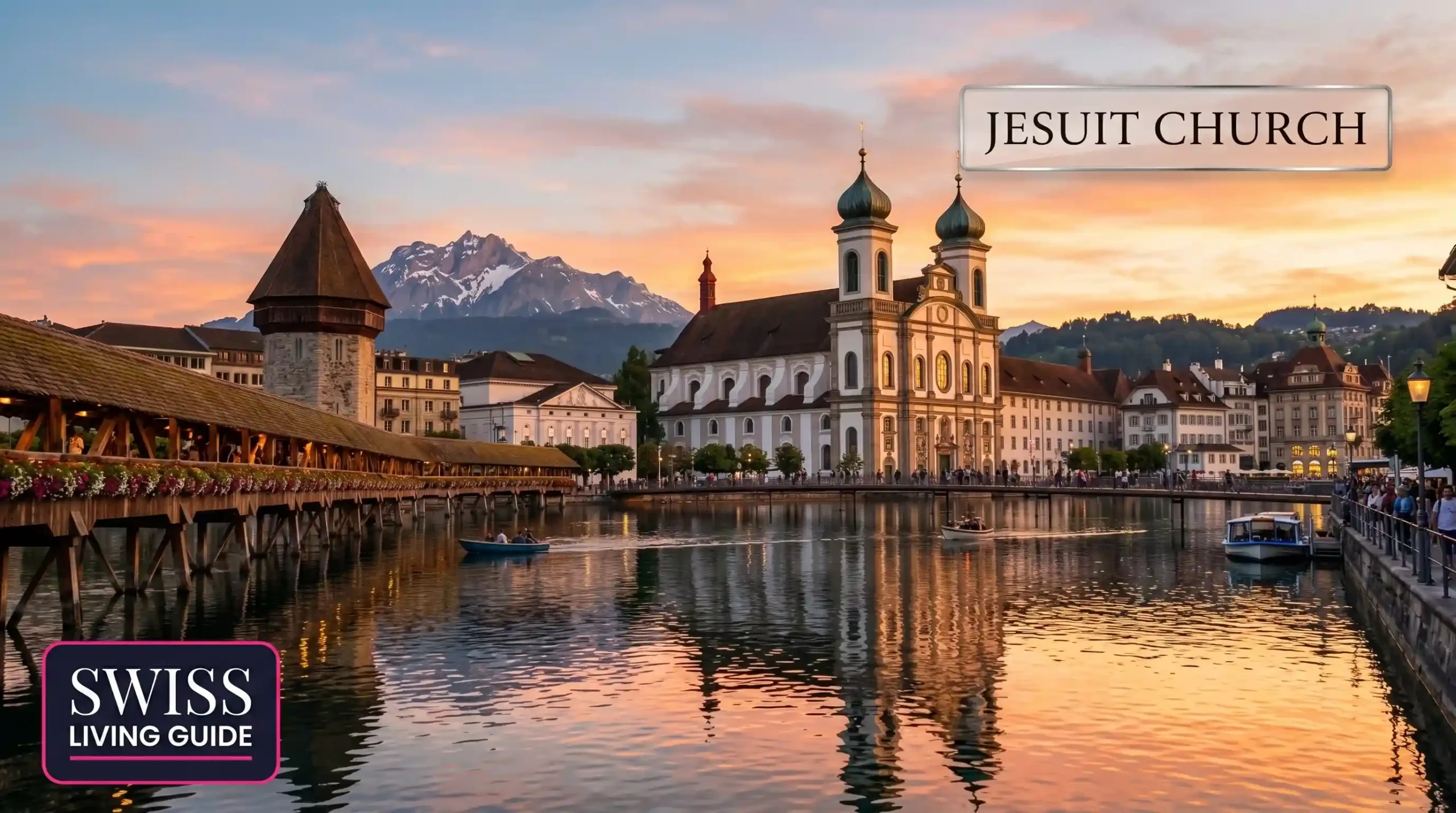
The Jesuit Church of St. Francis Xavier, built between 1666 and 1677, holds the distinction of being the first large Baroque church constructed north of the Alps in the German-speaking world. Its twin onion-domed towers and pale rose façade make it one of the most recognisable landmarks on the south bank of the Reuss River, directly across the water from the Old Town.
Inside, the church is a masterpiece of High Baroque decoration. Stucco ceiling medallions, gilded frescoed vaults, and a nave that draws the eye inexorably toward the high altar create an atmosphere of remarkable grandeur. Admission is free and the church remains an active place of worship. Visit early in the morning or late afternoon for the most peaceful experience.

Swiss Museum of Transport (Verkehrshaus)
Located on the eastern shore of Lake Lucerne, about 15 minutes on foot or a short bus ride from the Old Town, the Swiss Museum of Transport is the most visited museum in Switzerland, and it earns that distinction fully. Every form of transportation is represented here: railways, road vehicles, aviation, maritime history, space exploration, and telecommunications, all delivered with wide-ranging interactive and immersive exhibits.
The museum also houses a Planetarium, a Swiss Chocolate Adventure experience, and a Media Globe cinema presenting sweeping panoramic films of the Swiss landscape. Allow at least half a day. It is one of the most family-friendly attractions in German-speaking Switzerland, but genuinely enjoyable for adults as well. Admission is approximately CHF 32 for adults; Swiss Travel Pass holders receive a discount.
Rosengart Collection (Sammlung Rosengart)
The Rosengart Collection houses one of Europe’s finest private collections of Modernist art, centred on Pablo Picasso and Paul Klee. Located in a handsome historic building steps from Lucerne Railway Station, the gallery presents over 230 works from Picasso’s career alongside paintings, watercolours, and drawings by Klee, Braque, Cézanne, Monet, and Miró.
What makes the collection especially intimate is the personal story behind it. Dealer Siegfried Rosengart and his daughter Angela were close friends of Picasso, and the collection includes rare personal photographs documenting that friendship. An extraordinary cultural counterpoint in a city better known for its landscapes. Admission approximately CHF 23.
Best Time to Visit Lucerne
Lucerne is a rewarding destination in every season, but the timing of your visit significantly affects what you can experience, from open mountain railways and lake swimming to Christmas markets and snow-dusted rooftops.
| Season | Months | Temperature | Crowds | Best For |
|---|---|---|---|---|
| Spring | March–May | 8–18°C | Low–Medium | Wildflowers, fewer tourists, mountain views with snow still on peaks |
| Summer | June–August | 18–28°C | High | Lake swimming, all mountain lifts open, festivals, outdoor dining |
| Autumn | September–November | 10–20°C | Low–Medium | Autumn foliage, photography, quieter streets, lower hotel prices |
| Winter | December–February | 0–8°C | Low | Christmas markets, cosy fondue evenings, snowy mountain backdrops |
For most visitors, May to June and September are the ideal months. The weather is pleasant and warm, the lake is blue and inviting, all mountain railways and cable cars are operating, and the most intense summer crowds have not yet arrived, or have subsided. July and August are peak season: hotel prices are at their highest, the waterfront promenade is busy, and Mount Pilatus queues can be long. Book well in advance if visiting in summer.
Winter offers a different and equally appealing Lucerne. The Christmas market on the lakefront (usually early December) is one of Switzerland’s most atmospheric, and the city’s luxury hotels drop their rates considerably from November through February. The best time to visit Switzerland overall aligns broadly with Lucerne’s optimal windows.
Where to Stay in Lucerne
Lucerne is a compact city and most accommodation is within easy reach of the main sights. Where you stay shapes your experience of the city, here are the three best areas.
| Budget Level | Accommodation/Night | Meals/Day | Activities/Day | Approx. Daily Total |
|---|---|---|---|---|
| Budget | CHF 80–120 | CHF 30–50 | CHF 0–20 (free sights) | CHF 110–190 |
| Mid-Range | CHF 150–280 | CHF 60–100 | CHF 50–90 (museum + cruise) | CHF 260–470 |
| Luxury | CHF 300–900+ | CHF 100–200+ | CHF 80–250 (Pilatus + private cruise) | CHF 480–1,350+ |

How to Get to Lucerne
Getting to Lucerne is straightforward from anywhere in Switzerland. By train is the easiest and most enjoyable method, and the journey from Zurich Airport to the city centre takes well under an hour.

Getting Around Lucerne
Lucerne’s compact size makes walking the natural default for most visitors. Beyond the Old Town, an efficient network of buses and lake boats extends your reach across the region.
- On foot:
- The Chapel Bridge, Old Town, Lion Monument, Musegg Wall, Jesuit Church, and lakefront promenade are all within 10–15 minutes’ walk of each other. The vast majority of first-time visitors never need public transport within the city centre itself.
- Public buses (VBL):
- Lucerne’s bus network is clean, punctual, and simple to navigate. Single tickets cost approximately CHF 2.50–4 depending on zone. A day pass for zones 10 and 19 covers the city and costs around CHF 9. Swiss Travel Pass holders travel free on all VBL routes.
- Lake boats:
- Regular boat services from the lakefront pier connect central Lucerne to villages along the lake including Weggis (for Mount Rigi) and Alpnachstad (for the Pilatus cogwheel railway). The Lake Lucerne Navigation Company operates these routes; Swiss Travel Pass included.
- Bicycles:
- Rental bikes are available from several operators near the station and are a pleasant option for the flat lakefront path and Tribschen peninsula. Many hotels also provide guest bicycles free of charge.
Luzern-Card / Guest Card: Guests staying at participating hotels receive a Luzern-Card entitling them to free or discounted public transport, reduced museum entry, and other city benefits. Ask at check-in.

Where to Eat in Lucerne
Lucerne’s food scene ranges from traditional Swiss mountain classics to refined lakeside fine dining, and the setting alone elevates almost every meal you eat here.
The essential Swiss dining experience in Lucerne is fondue: melted Gruyère and Emmental cheese served in an earthenware pot with bread, cornichons, and small potatoes. It belongs firmly in the category of food that tastes meaningfully better when eaten in Switzerland, ideally at a wooden table with a lake view. Expect to pay CHF 25–40 per person at a mid-range restaurant.
Rösti: Switzerland’s answer to a hash brown, often served topped with cheese, eggs, or smoked ham, is another Old Town staple, widely available at traditional restaurants in the Altstadt. Raclette (melted mountain cheese scraped onto potatoes and charcuterie) is equally beloved, particularly in autumn and winter when the mountain warmth of the dish feels entirely appropriate.
For lakeside dining, the restaurants along the Nationalquai and Schweizerhofquai promenades deliver elevated menus, impeccable service, and views over Lake Lucerne that are genuinely difficult to walk away from. Reserve tables in advance for dinner, especially from May to September. Many top restaurants in Lucerne also offer lunch menus at significantly reduced prices, an excellent strategy for luxury food at more manageable cost.
The Old Town is dotted with excellent cafés and chocolate shops. Lucerne’s proximity to the Gruyères and Emmental regions means local dairy-based chocolates and pralines here are exceptional. Pick up local chocolate as gifts, it travels well and far outclasses anything sold at the airport.

Best Day Trips from Lucerne
Lucerne’s position in central Switzerland makes it one of the best bases for day excursions in the country. Mountains, lakes, and historic cities are all within easy reach.
Mount Pilatus (2,132m): The classic Lucerne excursion. Take the lake boat from Lucerne to Alpnachstad, ride the world’s steepest cogwheel railway to the summit, enjoy the panoramic views over Lake Lucerne and the Alps, then descend by cable car to Kriens and bus back to the city. A full round trip costs approximately CHF 72–80; Swiss Travel Pass holders receive a 50% discount on the mountain sections.
Mount Rigi (1,797m): Known as the “Queen of the Mountains,” Rigi is reached by lake boat to Vitznau followed by the oldest mountain railway in Europe. Less dramatic than Pilatus but more relaxed, with gentle walking trails and sweeping sunrise views that have attracted European royalty since the 19th century.
Engelberg & Mount Titlis: A 45-minute train ride south of Lucerne, Engelberg is the gateway to Mount Titlis (3,020m) and its revolving cable car, year-round glacier, and ice cave. An excellent full-day family adventure. The journey itself through the central Swiss valleys is scenic.
Lake Lucerne Cruise: A full-day paddle steamer cruise visiting villages around the lake including Brunnen, Flüelen, and the meadow at Rütli, the symbolic birthplace of the Swiss Confederation. Entirely covered by Swiss Travel Pass.
Zurich: Switzerland’s largest city is 50 minutes away by direct train. Combine a Lucerne base with a Zurich day trip for galleries, shopping along Bahnhofstrasse, and the lakefront Zürichsee.

Sample 2-Day Lucerne Itinerary
Two days give you enough time to explore the city thoroughly and take one mountain or lake excursion without feeling rushed.
Day 1: The City
08:00
Walk the Chapel Bridge before the crowds arrive. Photograph from the north bank with morning light on the peaks behind.
09:30
Explore the Old Town, Weinmarkt and Kornmarkt squares, painted façades, the Rathaus building, and a coffee at a terrace café.
12:00
Lunch at a traditional restaurant in the Old Town. Try rösti or a soup-and-bread set menu for CHF 18–25.
13:30
Lion Monument, allow 20 minutes. Then walk north to the Musegg Wall and climb the Zyt Tower for Old Town rooftop views.
16:00
Walk the lakefront promenade toward Inseli Park. Stop at the Jesuit Church on the south bank before returning for the evening.
19:30
Dinner at a lakeside restaurant, fondue or raclette recommended. Book ahead for window tables with lake views.
Day 2, Mountain & Lake
07:30
Early start: board the lake boat from Lucerne to Alpnachstad (45 min) and ride the cogwheel railway to the summit of Mount Pilatus.
10:30
Summit time: panoramic restaurant, short walking trails, views over the Alps and Lake Lucerne far below.
12:30
Descend by cable car to Kriens, then bus back to Lucerne centre. Picnic lunch on the lakefront with mountain views.
14:30
Visit the Swiss Museum of Transport (allow 2–3 hours) or join a short afternoon lake boat cruise from the main pier.
17:30
Final stroll through the Old Town. Browse chocolate shops and Swiss watch boutiques. Pick up gifts before dinner.
19:30
Farewell dinner, fine dining or a final fondue in a classic Old Town cellar restaurant.
Local Travel Tips for Lucerne
A few practical details that make the difference between a smooth and a frustrating trip. Switzerland operates on its own terms, knowing them in advance saves time and money.
| Topic | What You Need to Know |
|---|---|
| Currency | Swiss Franc (CHF). ATMs are widely available. Most shops, restaurants, and hotels accept Visa and Mastercard. Euros accepted at major tourist spots but at an unfavourable exchange rate; use CHF. |
| Tipping | Not mandatory in Switzerland. Service is included by law. Rounding up to the nearest CHF 5 or leaving 5–10% is appreciated but never expected. |
| Safety | Lucerne is extremely safe. Petty theft can occur in crowded tourist areas, keep bags secure near the train station and Chapel Bridge. Emergency: 112 (Europe-wide) or 117 (Swiss police), 144 (ambulance). |
| Drinking Water | Tap water in Lucerne is outstanding quality, cold, clean, and entirely safe to drink directly from the tap. Street drinking fountains are also safe and common throughout the Old Town. |
| Public Toilets | Pay toilets (CHF 0.50–1) operate in the train station and some public areas. Department stores and museums have free facilities. Keep a few coins handy. |
| Power Plugs | Switzerland uses Type J plugs (three round pins). Many Swiss hotels provide adapters, but carry a universal travel adapter for older properties. |
| Language | German is official; Swiss-German (Schweizerdeutsch) is spoken locally. English is widely understood and spoken throughout central Lucerne. Basic German greetings (Grüezi, Danke) are warmly received. |
| Sunday Opening | Most shops in Lucerne are closed on Sundays. Tourist-facing shops in the Old Town may open shorter hours. Supermarkets at the train station operate seven days a week. |
| Mountain Weather | Mountain conditions change rapidly. Carry a light waterproof layer even in summer when heading to Pilatus or Rigi, summit temperatures can be 10–15°C cooler than the city. |

Is Lucerne Worth Visiting?
The short answer is yes, emphatically. Lucerne delivers more visual impact per square metre than almost any other city in Switzerland.
Its small size is one of its greatest assets. You can walk the entire Old Town in twenty minutes, yet it never feels slight or easily exhausted. The combination of lake, mountain, medieval architecture, and excellent transport links to wider Switzerland gives Lucerne unusual density of experience for its modest footprint.
That said, Lucerne is not the ideal choice for every traveller. Those seeking vibrant nightlife or a major urban cultural programme will find Zurich or Geneva more satisfying. Travelers who prioritise serious mountain hiking may prefer Interlaken as a base, which offers more immediate access to the high Alpine trails of the Bernese Oberland. For everyone else, couples, families, first-time visitors, luxury travellers, and photographers, Lucerne is among the finest cities Switzerland has to offer.
| If You Want… | Is Lucerne a Good Choice? |
|---|---|
| Luxury lakeside hotels | ⭐⭐⭐⭐⭐ |
| Romantic getaway | ⭐⭐⭐⭐⭐ |
| Family vacation | ⭐⭐⭐⭐⭐ |
| Scenic train journeys | ⭐⭐⭐⭐⭐ |
| Hiking and mountain trips | ⭐⭐⭐⭐⭐ |
| Easy public transport | ⭐⭐⭐⭐⭐ |
| Nightlife | ⭐⭐⭐ |
| Budget travel | ⭐⭐⭐ |
Lucerne Is Worth Every Moment
Lucerne earns its reputation as one of Switzerland’s most beautiful cities through genuine, layered quality rather than a single headline attraction. The Chapel Bridge and Lake Lucerne are iconic, but what keeps visitors coming back is the way the whole city coheres: the painted guild houses, the medieval wall towers, the mountain-framed morning light on the lake, the ease of getting absolutely anywhere by train or boat.
Whether you have a single afternoon or a long weekend, Lucerne will show you something remarkable at every turn. Combine it with a mountain excursion to Mount Pilatus or Rigi, explore the wider Swiss landscape with a Swiss Travel Pass, and use our related guides below to plan every detail of your Switzerland trip with confidence.
For more Switzerland travel inspiration, browse our city guides, transport guides, and seasonal travel tips at SwissLivingGuide.com.
Frequently Asked Questions About Lucerne
Yes, absolutely. Lucerne combines a medieval Old Town, the iconic Chapel Bridge, beautiful Lake Lucerne, and easy Swiss Alps access, all within a compact, walkable city. Most visitors rank it among Switzerland’s most beautiful destinations. The scenery, transport links, and overall visitor experience make it one of the best cities to include on any Switzerland itinerary.
Yes, Lucerne is expensive by most international standards. A mid-range dinner costs CHF 30–50 per person, a hotel room CHF 150–300+ per night, and a return trip to Mount Pilatus around CHF 72–80. Budget travellers can reduce costs by using a Swiss Travel Pass, visiting free attractions (Chapel Bridge, Lion Monument, Musegg Wall), and buying groceries for daytime meals.
Lucerne is extremely walkable. The Chapel Bridge, Old Town, Lion Monument, Musegg Wall, Jesuit Church, and lakefront promenade are all within 10–15 minutes on foot of each other. You can comfortably cover the city’s main attractions in a few hours of easy walking. Public buses and lake boats extend your reach for longer distances.
Yes, Lucerne is one of the safest cities in Europe. Switzerland consistently ranks among the world’s safest countries, and Lucerne has very low crime rates. Standard travel precautions apply in crowded tourist areas, keep bags secure and be aware of your surroundings near the train station. For emergencies: dial 112 (Europe-wide), 117 (police), or 144 (ambulance).
Yes, easily. Direct IC trains run every 30 minutes from Zurich HB and arrive in Lucerne in approximately 50 minutes. You can comfortably explore the Old Town, Chapel Bridge, and lakefront in a single day. However, an overnight stay significantly enriches the experience, the city transforms in the early morning and evening when the day-trip crowds have gone.


